Some Words
Porcelain wavers between the doll's house and the nuclear power plant. Or better: without wavering at all, it spans both poles, like an ontological leveller. The doll's house and the nuclear power plant both hold great generative power —great destructive power— which porcelain contains and tempers in its delicate indifference: zen master and dominatrix.
From aristocratic refinement to the crude oil refinery, porcelain displays a great chemical inertia; a supernatural capacity to remain unaltered in the most toxic and extreme environments. Like a mystic at the stake (Marguerite Porete). There are valves, resistors and any number of industrial components still produced by one of the oldest craft techniques known to humankind. Thousands of years ago porcelain was part of Chinese imperial protocol, just as today it is part of the most delicate mechanisms of energy production. Which is to say that, deep down, the uses of porcelain have changed very little.
It turns out that craft is not at odds with precision and progress; that this technology of the feminine and the domestic is one of the most advanced, while being archaic. It is not, then, that this is the minor pole and the industrial one the major pole of the spectrum porcelain covers, but rather that playing house is something extremely serious. A game as serious as the fission of the atom, or as Borges's lottery in Babylon, which little by little takes possession of life, hidden and at the same time present at every moment, until it becomes more powerful than the state and swallows it whole. Games which, as befits any game, do not exclude chance, and before which there is nothing for it but to stand to attention.
But chance, as the artist reminds us in the piece titled Hazard, is not opposed to order: it is one of its fundamental conditions. One might even ask whether it is the rules that lend the game its seriousness or whether, rather, we take the game more seriously precisely because of the ominous and capricious presence of chance within it. This term of Arabic origin, which refers back to a game of dice, points to a complicity with a danger that has to be assumed in order to play, since "throwing them implies temporarily accepting the loss of control in order to activate other possible forms of relation, decision and interpretation", the artist explains in her studio.
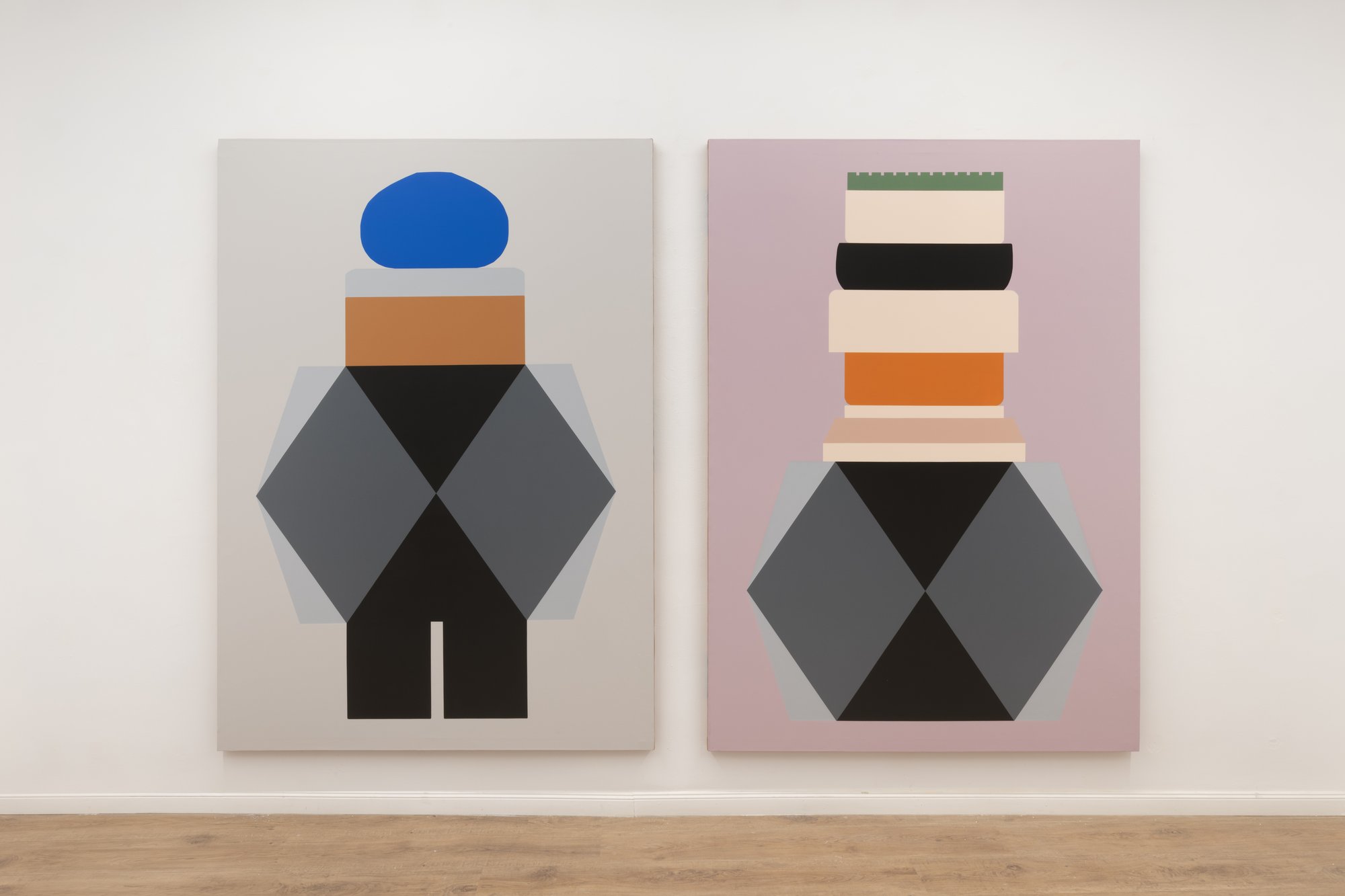
Throughout the exhibition one recognises elements of play that remain unstable, like those dice thrown into the air. In that liminal space something appears that resembles a chess piece, a spinning top, a diabolo, but also a mallet, or a baby's teat, or a butt plug. As in those Gestalt optical illusions, the resemblances follow one another lysergically. The works in this exhibition are composed of geometries that remind us of other games, yet they build systems that precisely call into question the stability of the rules. Thus, "the works construct a space where the rules do not disappear, but neither do they quite stabilise; where each object seems to retain the partial memory of a use, a match, or a system still under construction".
Why does the artist blow up, subtly but firmly, every game board, without singling any one out? The key may lie in the fact that "a game board is a reduced form of the world". It is these reduced forms of the world that here open onto one another, blurring. The only game the artist does not subject to this procedure is one that already has no rules: Perros y chacales [Hounds and Jackals], "one of the oldest games preserved by archaeology", whose rules nobody knows.
Each game establishes an order, then, though some are more open than others. The astral game, for instance, is referenced in Campo de juego [Playing Field], a work in which the constellations on the walls (Orion, Canis Maior and Canis Minor: the hunter and his dogs) "function as points of reference" for a game table that "invites the viewer to build a vertical structure out of different modules". The game consists in establishing a connection with the celestial, with that sky we look at and which, in turn, looks back at us; it obliges us to look at ourselves and to interpret ourselves.
The little tower each person builds in this work becomes a resistor and a conduit, a mediating device of force, one that withstands the conversion of one force into another without breaking. It is a story as old as porcelain: art and artists are (can be) resistors, power converters or transducers (which turn one kind of energy into another). In this order of things, the production of these pieces has something mediumistic about it. And porcelain does not negotiate. You have to listen to it in order to invent with it, to be one with it. There are some written rules, and others that demand an ear, as in these strange games.
The exhibition, let us recall, proposes that we play gato (cat, the Spanish name for noughts and crosses) on a toro (a bull, but also a circular torus) which, for those who don't know, is an annular geometric form (like a ring doughnut, but hollow inside). A fundamental form in processes such as particle acceleration or magnetic nuclear fusion. I have even read that some of these toroidal reactors were built, at least during the fifties and sixties, in porcelain, and that even today many of their components are made using this ceramic technique.
Sandra's games have no clear end. There is no knowing who wins, or why. There are no instructions, no tutorial posted on youtube. They exist in a space where the rules are still to be discovered, as the zodiac was once still to be discovered. Some of you will be sure that it is not a matter of discovering but of inventing, but here discovering and inventing are part of the same process of worlding. One discovers by inventing; one invents by discovering.
Claudia Rodríguez-Ponga
-Sandra Val's quotations come from a studio visit by the author, 2026.-